
State of Unreal 2026
Takeaways from a recent State of Unreal presentation and they might impact CAD software for AEC.
Epic recently presented a vision for the next generation of Unreal Engine. There are a good number of developments that I believe will eventually have an impact on the shape of CAD for architecture, engineering, and construction (AEC) industries.
Here’s the meat of the presentation if you want to watch it straight through, which starts after 20 minutes of sizzle reel.
1. Elastically-scaled real-time cloud compute will enable massively multiplayer game environments – and massively multiplayer design projects.
Epic’s CEO Tim Sweeney has made it a priority to develop a platform that will allow it to outcompete Roblox, a massively multiplayer game platform. Epic’s goal is to create a massive, persistent, interoperable digital space where players can move from one game environment to another.
In order to enable this, Unreal will need to be able to connect a large number of virtual worlds across hundreds or thousands of servers while being able to synchronize state across servers and connected clients. While the primary goal for this technology will be essential for creating massively multiplayer spaces, it’ll also be tremendously useful for collaborating on designing very large scale projects. One can imagine in the age of agentic AI, collaborators won’t just be designers and engineers, they’ll also be specialized agents.
When it’s possible to elastically scale the number of servers that Unreal can run on, the complexity of the structures, environments, systems, and machines that can be designed, built, and delivered will go up. With enough computational capacity, it will be possible to simulate very large and complex things to a very high degree of detail. Imagine simulating an entire airport while tuning the design in real time.
This isn’t all that much of a stretch. A number of games today are multiplayer design tools in their own right. Games like Minecraft, Satisfactory, Roblox, Fortnite are all great examples of design tools masquerading as games.
Massively multiplayer games will mean massively multiplayer design tools able to operate in real-time simulated spaces. Microsoft Flight Simulator is a good example of a highly detailed world-scale simulation that utilizes GIS and weather data:
Once Unreal can operate on elastically scaled cloud compute, I think we’ll see it be the basis for developing digital twin design and simulation platforms that will perform many of the same functions as Nvidia’s Omniverse. I suspect that Unreal’s massive developer base will be an asset for companies wanting to build next-gen CAD and digital twin tools.
When Unreal Engine can run on consumer-grade GPUs and elastically scaled data-center GPUs, I think this will be a powerful foundation upon which to build CAD software that’s aimed at serving organizations of people, rather than individual contributors tied to PC desktop hardware and software. Epic was rather cagey on when these capabilities will be available (they mentioned early access would be “late 2027-ish”), but I can’t imagine a better test case for hardening the infrastructure needed to enable distributed low-latency state management across hundreds of servers and thousands of clients.
Coordinated low-latency state management across servers and clients is a prerequisite for enabling concurrent editing of large and complex CAD designs. Think about how quickly Figma needs to operate when more than one user is collaborating in the same space.
A distributed software system that can enable massively multiplayer games like Fortnite will likely have many of the infrastructure building blocks needed to enable multiplayer design and construction applications. Unreal-enabled MMOs could be a powerful testbed for battle-testing real-time collaborative designing.
2. Open exchange standards will encourage collaborative content creation at scale.
In order for Epic’s vision of a large-scale persistent and interconnected 3D space to be viable, it requires massive amounts of high-quality content to be generated (a lesson that Meta learned the hard way). Massive amounts of content requires the establishment of a set of standards for supplying and ingesting the digital assets needed to populate the virtual world with content. Without this, the cost of ingesting 3D assets will be too high.
Open exchange standards for digital asset creation will make it possible for many 3D authoring tools to supply assets for Unreal Engine. The richer the ecosystem of creation tools that can integrate with Unreal, the better and more diverse the output and uses will be.
I think it’s very likely that we’ll see the ingestion of CAD data into Unreal Engine be significantly streamlined when Unreal and CAD tools speak USD natively.

The bet Epic is now making – the same that Nvidia did when it created Omniverse – is that design platforms that operate at large aggregate scales will ultimately thrive when content creation tools are decoupled from closed and proprietary file formats. I expect that Epic may ultimately get more traction than Nvidia owing to having more skin in the game (Nvidia’s attention is divided), the larger pool of developers Epic serves, and the large addressable audience for multiplayer games.
One of the primary benefits of open exchange standards is that they lower the cost of switching from one application to another. Legacy CAD software had been well-defended by making use of a combination of closed and proprietary file formats and breaking generational updates to those formats. When open exchange standards are agreed upon, designers will have more freedom to choose whatever authoring tool or technology is best for the job. When designs are decoupled from authoring tools, then tools are forced to compete for customers. When designs can move freely from one application to another the design becomes the center, rather than software tools that contribute to it.
As the AI industry turns more of its attention towards 3D and world models, it will need to look to data sources that haven’t been digested yet. As a result, I think we’ll see increased pressure for CAD software makers to adopt open exchange standards like USD and glTF.
Provided these formats can be custom-tailored for the needs of CAD designs, and provided game engines can consume them natively without loss in detail or fidelity, I think we’ll eventually see the creation of next-generation CAD software that assumes the same kinds of rich interactive capabilities that are available to game developers today.
A big question will be whether it makes any sort of economic sense for CAD software makers to attempt to build next-gen CAD software completely from scratch or whether there will be competitive advantages in building on top of something like Unreal Engine, despite having to pay to build with the software.
The jury is still out, but given the rate at which game engines continue to evolve, I suspect that the technological lift required for CAD software makers to build out the things that game engines can do will be far heavier than the lift for developers to modify game engines to be able to handle the needs of CAD software users.
Prior to the invention of agentic engineering, I assumed that the domain expertise required to build CAD software was just too rare of a commodity to make creating next gen CAD tools feasible – especially with the kinds of regulatory capture we see from legacy CAD software makers.
However, assuming agentic engineering continues to improve, it’ll open up the possibility for bigger architecture and engineering companies to build new CAD software up from scratch. I think expert practitioners often have a clearer idea about how they want their software to work than CAD software makers. AI has the potential to drive the cost of software creation down significantly, especially if it’s building on a set of agreed-upon standards for how things in a particular industry should be done.
3. Unreal Engine integrates AI through MCP server.
Epic announced the incorporation of chat-based AI into Unreal Engine 5.8. Epic’s implementation is quite smart, incorporating a chat window right into the Unreal workspace. Here’s the start of the AI section of the talk:
Unreal employs a MCP server which acts as a bridge between Unreal Engine and a game developer’s model of choice. Unreal’s MCP server gets access to engine systems - procedural content generation, blueprints, visual effects, materials, lighting. Customize by adding your own primitives, extensions, and skills.

Assets are composed through graphs of parametric manipulations. Over time, game developers can build a kind of procedural building grammar that can be used to aid in the procedural content generation of environments like cities.
Placed assets in a game environment are fully editable because they’re the same assets that Unreal would use anyway. This solves one of the major problems with using generative AI to create 3D animations – an inability to edit the output.
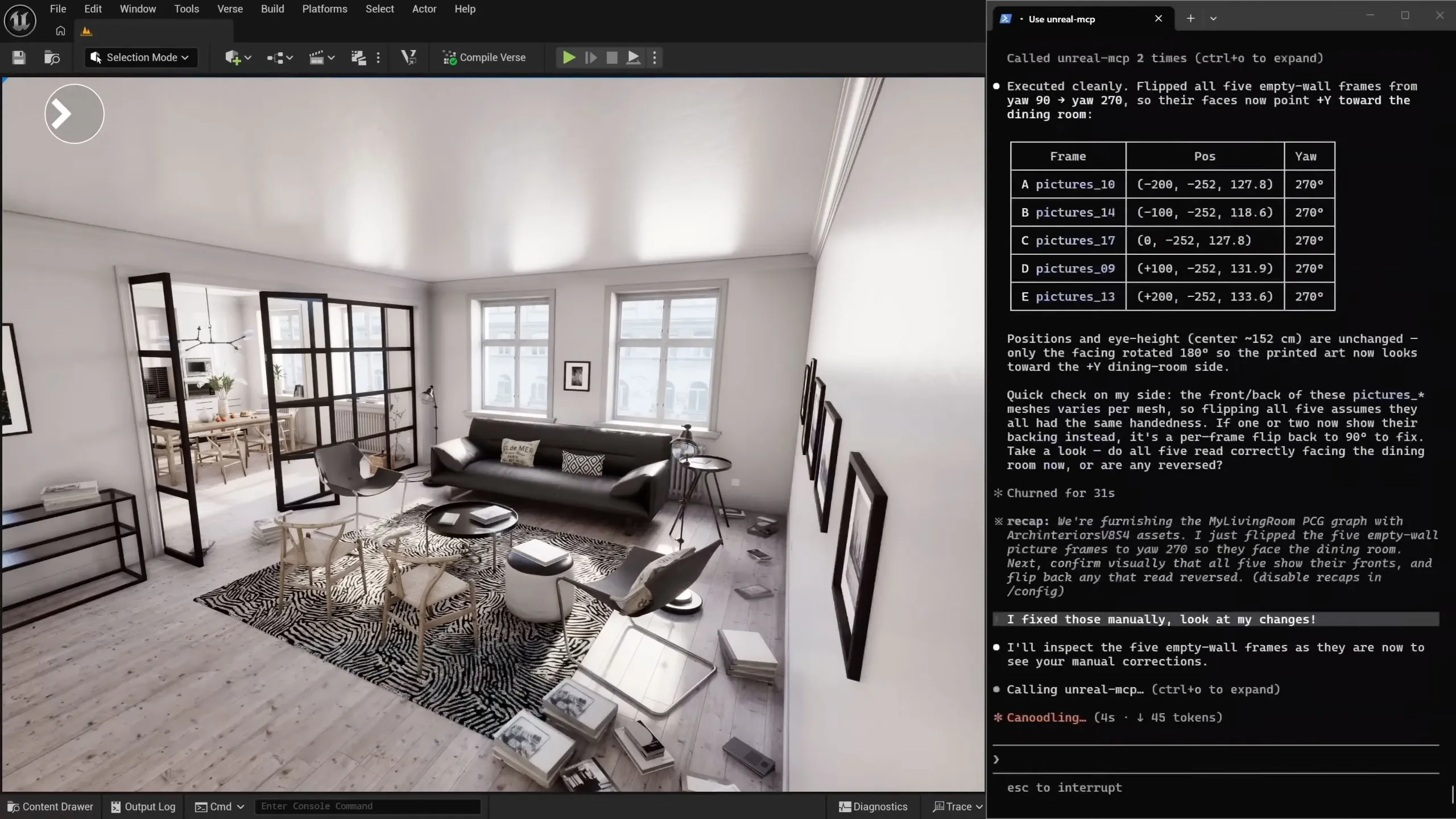
In reading the chat with the agent, it appears as if the agent’s ability to see what the user is pointing to in Unreal’s asset library is limited. It appears as if the agent is relying on analyzing screenshots of the UI rather than having access to Unreal’s UI state. I suspect that in the future, design tool makers will invest in exposing UI state in ways that make it easier for agents to natively understand how an application functions and what its current state is. Seems necessary to ensure that users and agents are talking about the same thing.
The usage demo in the video was sped up considerably and the time between request and result still feels laggy for small changes. I think it would be hard to reach flow state using a technology that introduces latency into the design process. Enabling flow state is one of the things that the best creative tools do, so it’ll be interesting to see whether agentic-enabled design software can ultimately deliver this. Hard to know when the underlying model is that the machine does part of the work.
The cost of the agentic work wasn’t discussed, so it’s unclear how affordable the work will be in practice. Perhaps this won’t be as big of an issue in the future as we figure out how to make smaller, more efficient, purpose-built models. Or maybe the gains in efficiency will be enough to offset the latency. Then again, maybe efficiency in production is the wrong thing to optimize for when you’re making something that needs to be sticky and interesting.
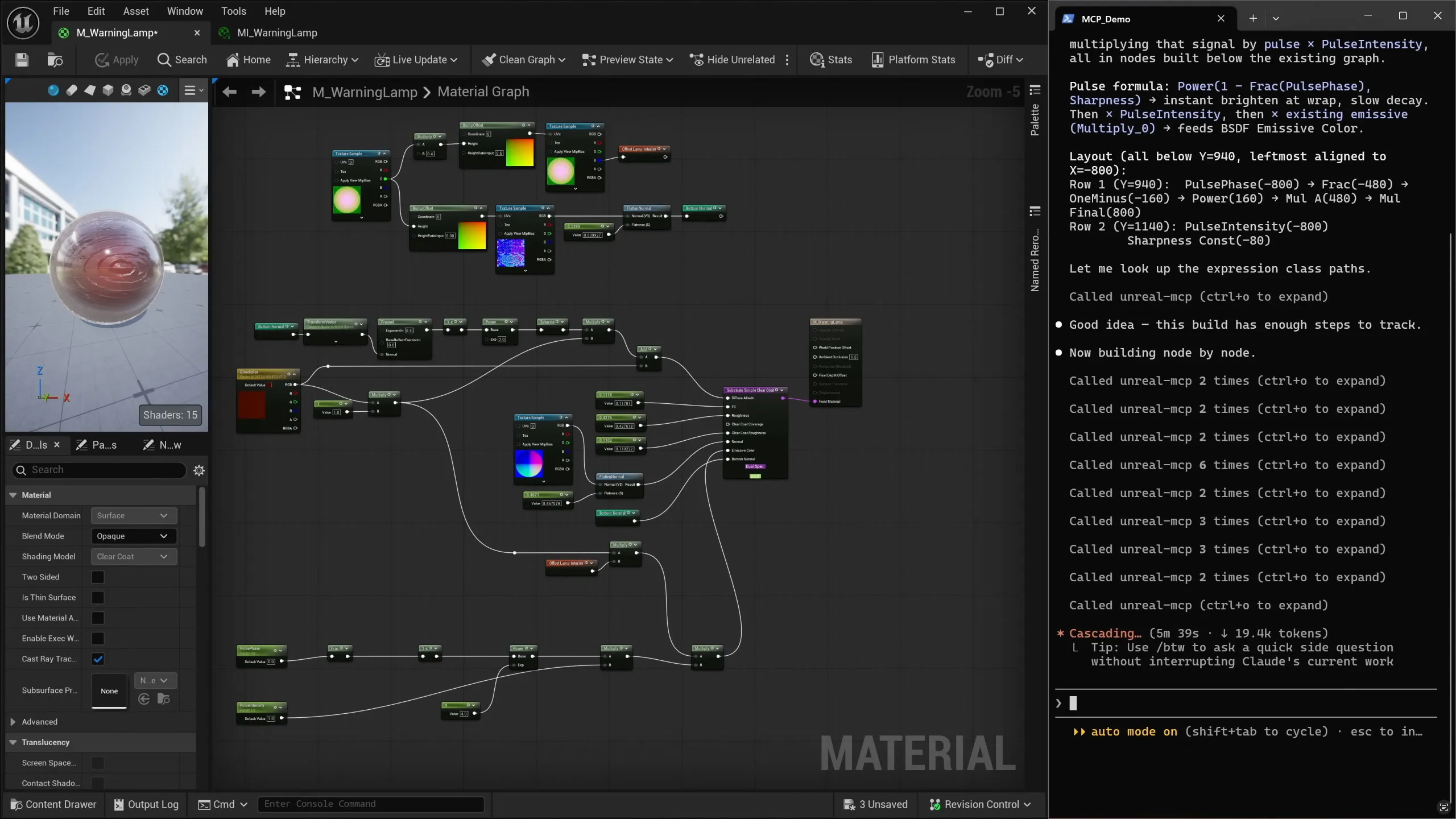
I think Unreal’s new agentic capabilities are aided by the fact that so much of game making is modular and procedural in nature. In Unreal’s demo the game developer is able to review the visible changes made in the nodal programming space, see the changes made in a live material viewer, and preview the result in gamespace in real time. Getting this kind of instant feedback instills confidence in the result, while also leaving a great deal of flexibility to further manually tweak the results.

Since a great deal of Unreal Engine’s technology is oriented around the procedural, parametric creation of game assets, behaviors, materials, game systems, environments, lighting, physics, particle effects and UI, it’s possible to have LLMs read the graph recipes for these things and understand how they are structured. Once the models understand how different flavors of procedural content is constructed, you can then ask them to make changes or additions based on text prompts.
Another interesting usage pattern was shown during the demo where a city was created by establishing a design grammar for the purposes of generating distinct districts in a city. The grammar is color-coded during the initial design phase and this forms the basis for designer and AI model to collaboratively build out a believable cityscape. It appears as if the model is told to look at an Unreal primitive that specifies the parameters and values that should be used to switch out the geometric primitives in the initial design phase.

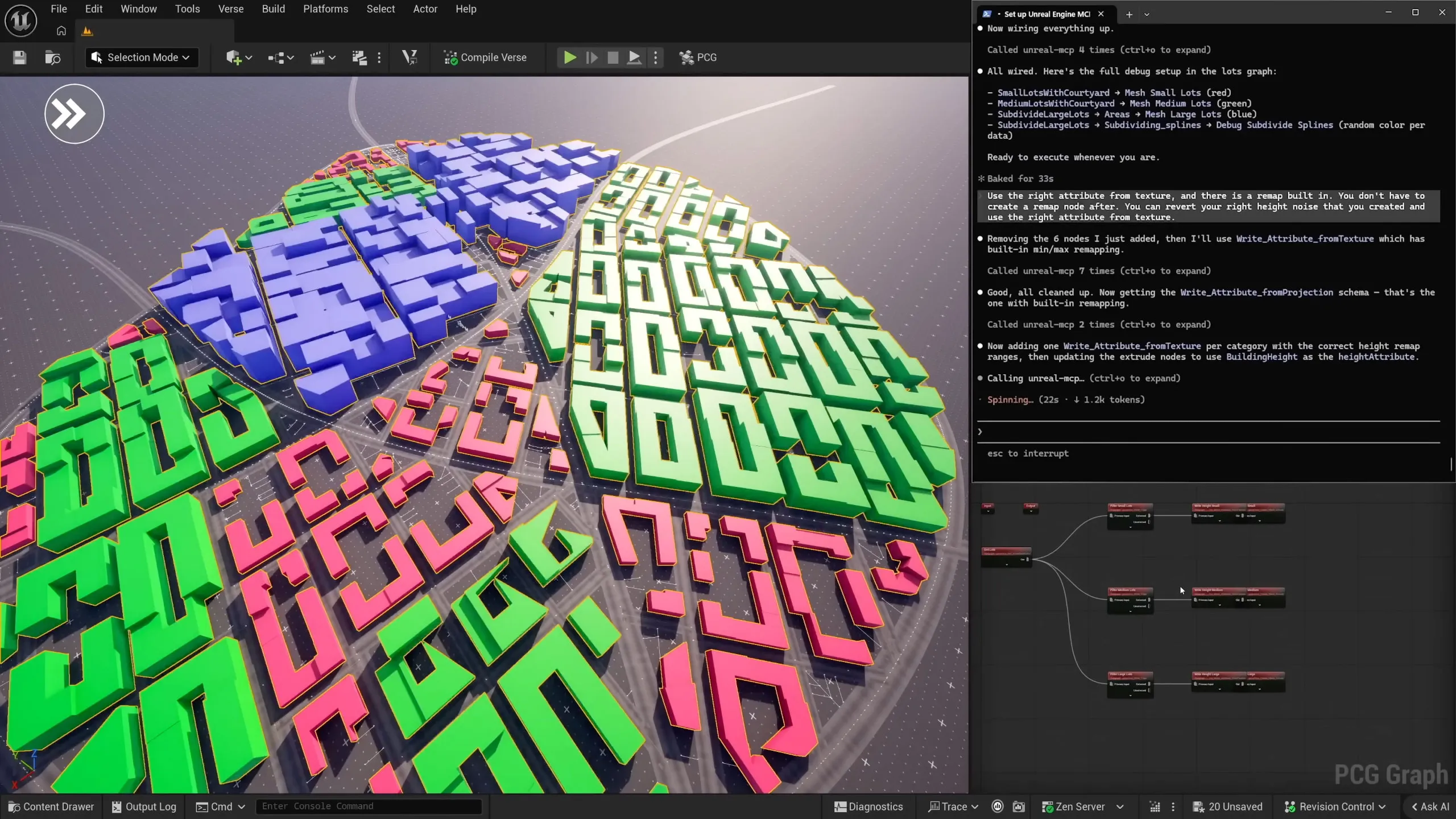

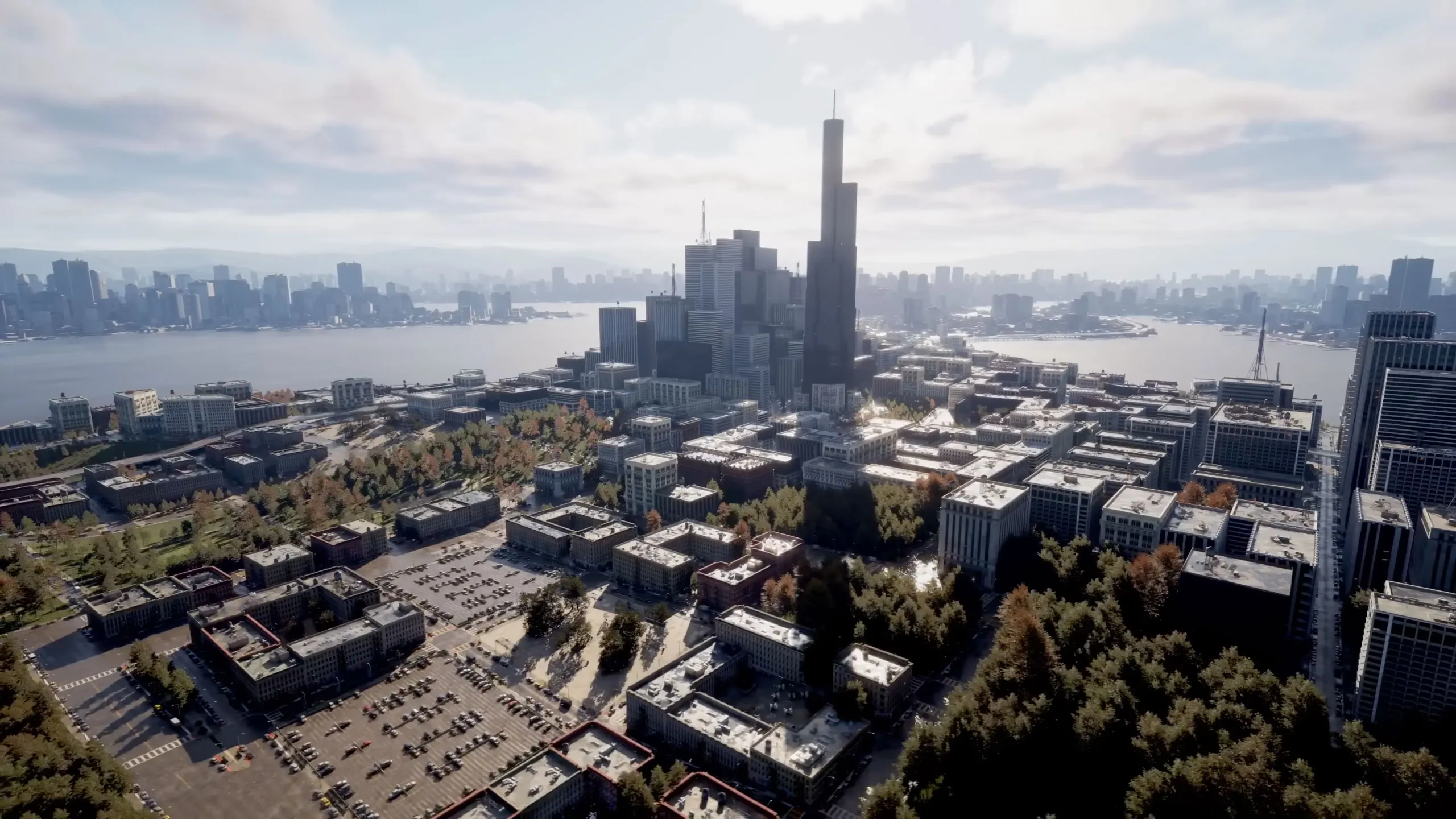
These kinds of temporary conceptual scaffolds can be a good way for designers to think through a complex design while providing a common language needed for constructively collaborating with AI models. I suspect this way of working will become a best practice in agentic-enabled designing and building.
Epic also demonstrated using a model to add UI elements in the Unreal editor workspace to adjust multiple parameters at once. This seems like it’ll be an effective way to bootstrap custom tooling for game content generation. The more composable a design platform’s UI is, the more amenable it will be to customizing via LLM.
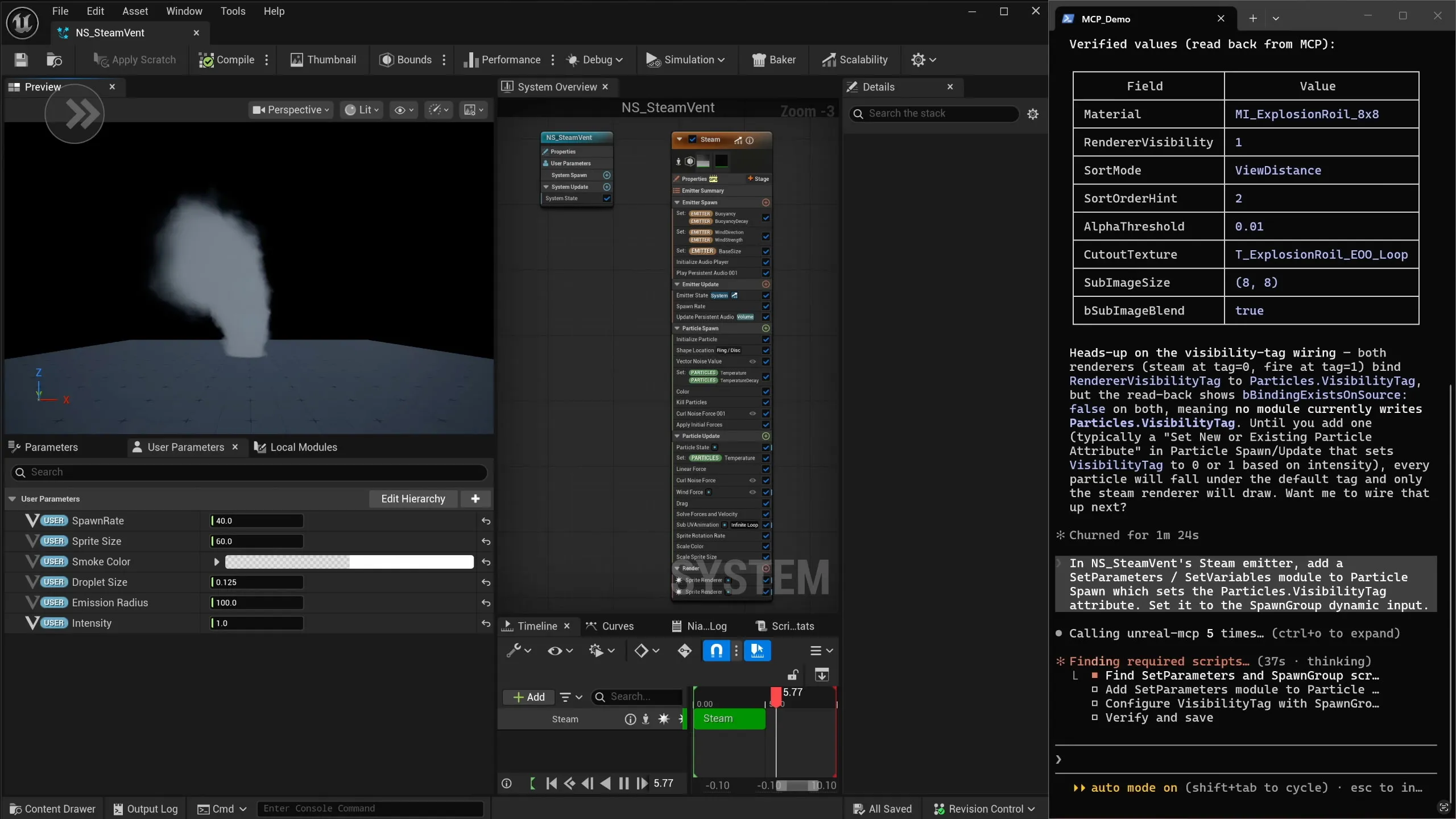
If this way of building custom interfaces and workflows turns out to be a useful pattern, then there’s a possibility that monolithic CAD design application UI will eventually be replaced by the ability for expert practitioners to assemble the UIs that make the most sense for the things they design, even on a per-project basis.
To illustrate, the UI needed for designing mechanical, electrical, and plumbing systems might be different than the UI needed for designing the structural elements of a building. The UI needed to design a house may be very different than the UI needed to design a hospital. In the future, maybe UI toolsets will be sharable / sellable things.
Unreal has launched with a solid starter kit for developers with procedural content generation building blocks, library of examples, and skills. Shows that they understand the space well, and these building blocks should be enough for teams to start experimenting and learning how to best incorporate AI into their game development workflows.
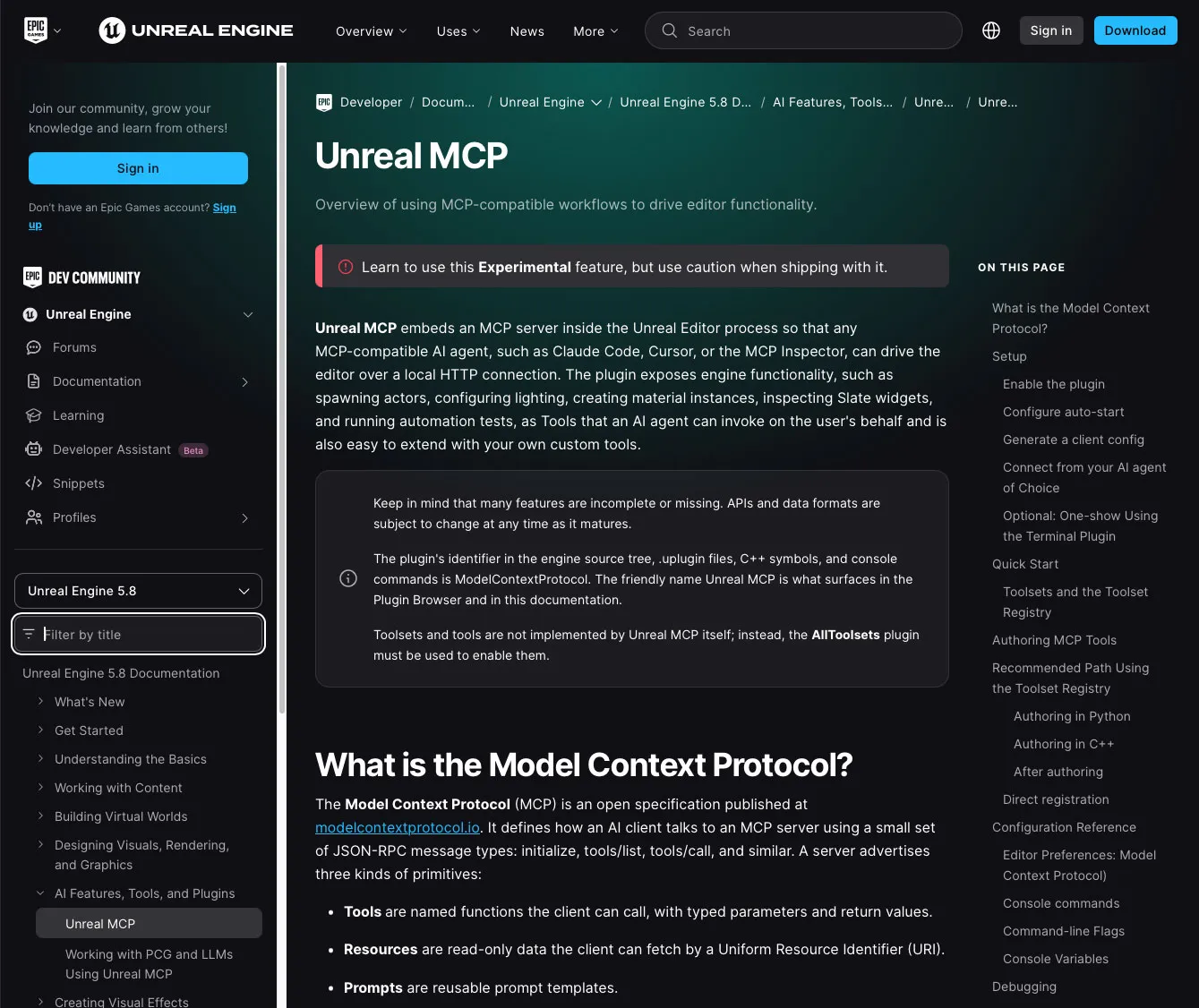
Unreal’s ability to incorporate AI tooling while preserving full editing control seems like a good model for other design software companies to follow. I’m guessing that the more a design tool is made up of modular, procedural, parametric, and relational entities, and the more these capabilities are already exposed via API, the easier it will be to incorporate generative workflows without degrading the people who use them.
4. Semantic search drives AI-enabled 3D composition.
Semantic search has been introduced in Unreal 5.8, and I’m guessing that this was required for agents to be able to find and “understand” the building blocks of a scene in Unreal.
I think the nature of games lends itself to semantic search. The bigger or more complex a game is, the more things it may contain. Things take up space and have certain behaviors attached to them. Players interact with the things in the space and a game’s physics and rulesets determine how the game responds to player input.
Semantic search makes it easier for humans and agents to access the primitive building blocks that games are made of.
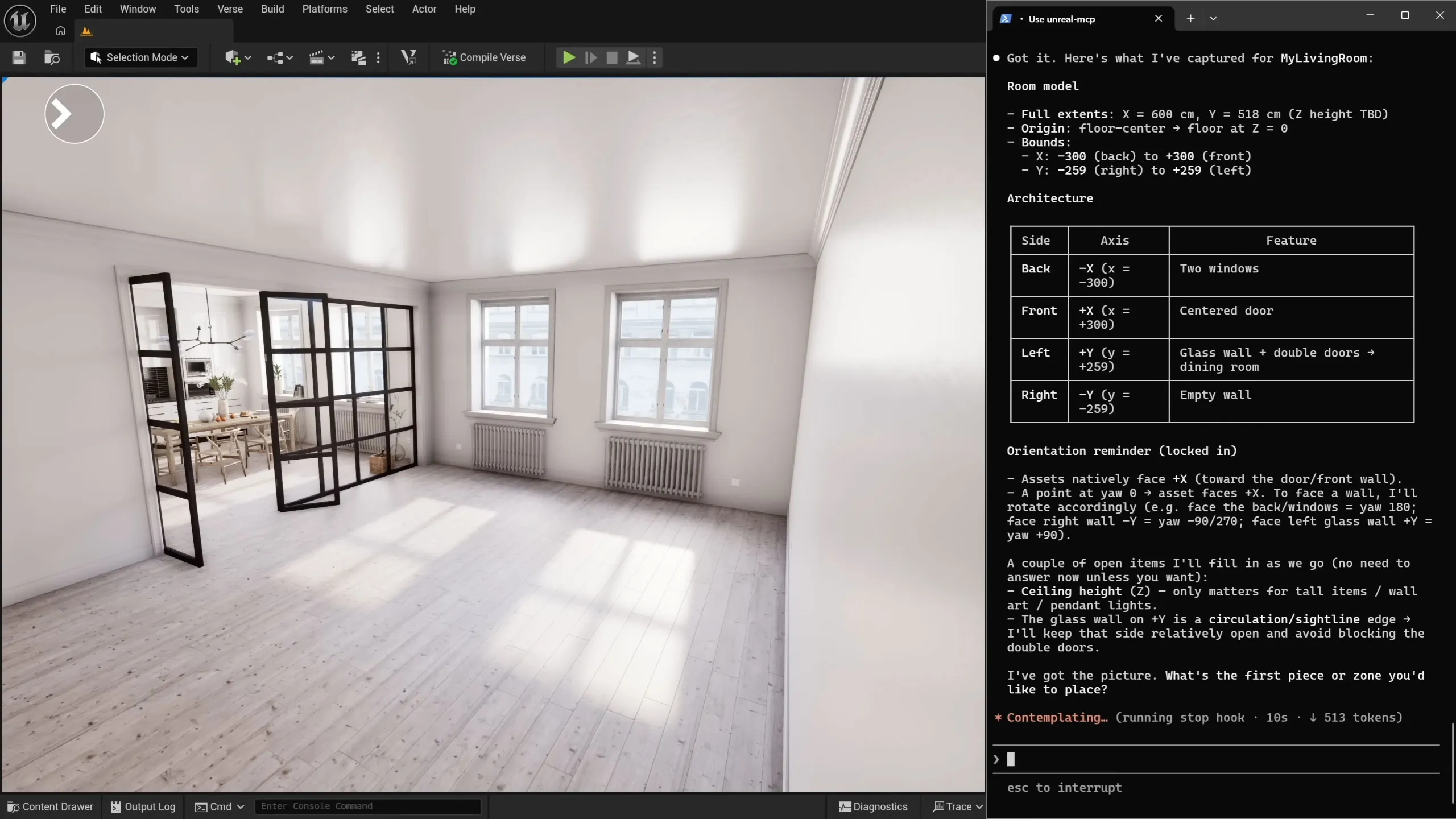

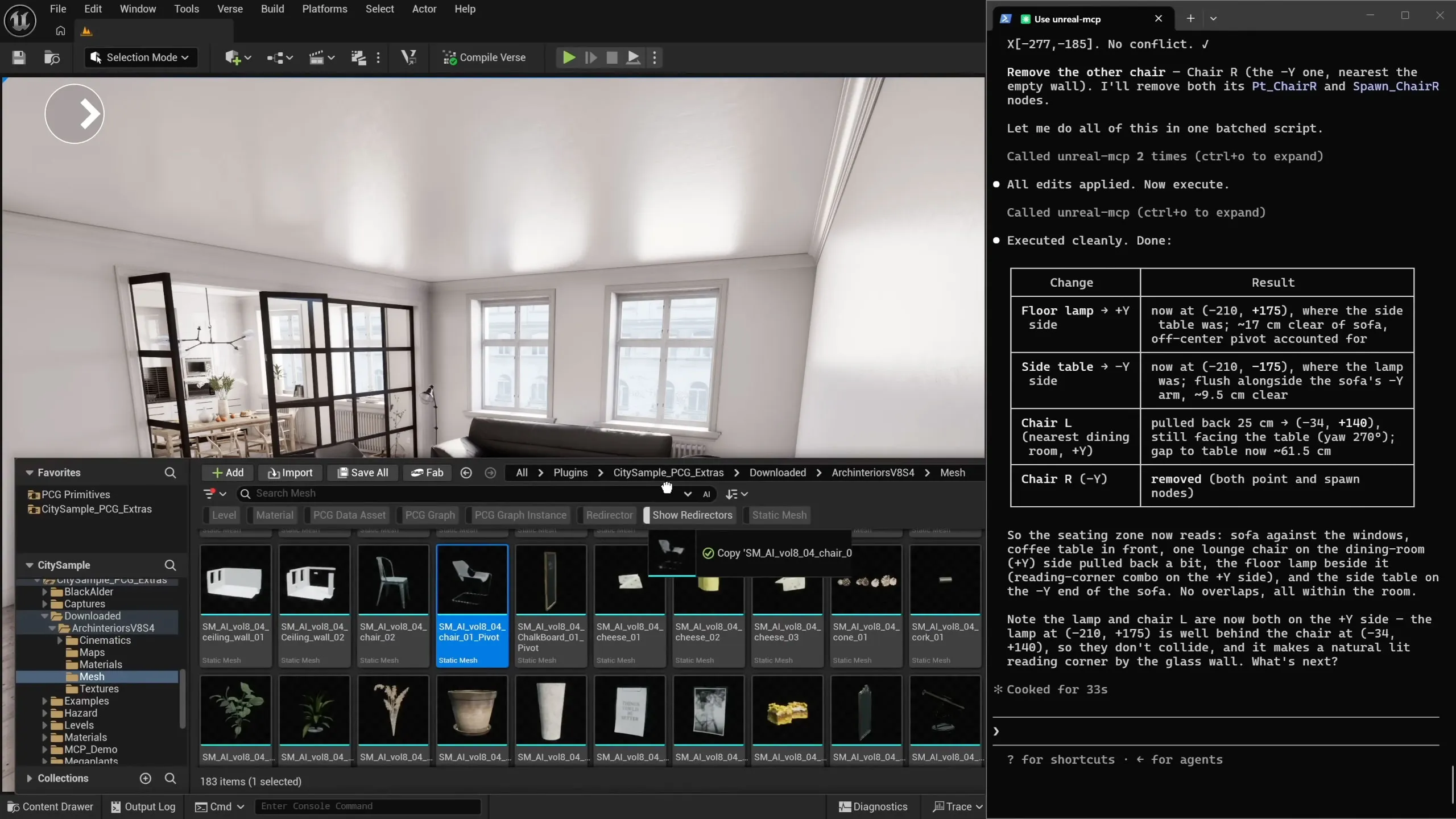
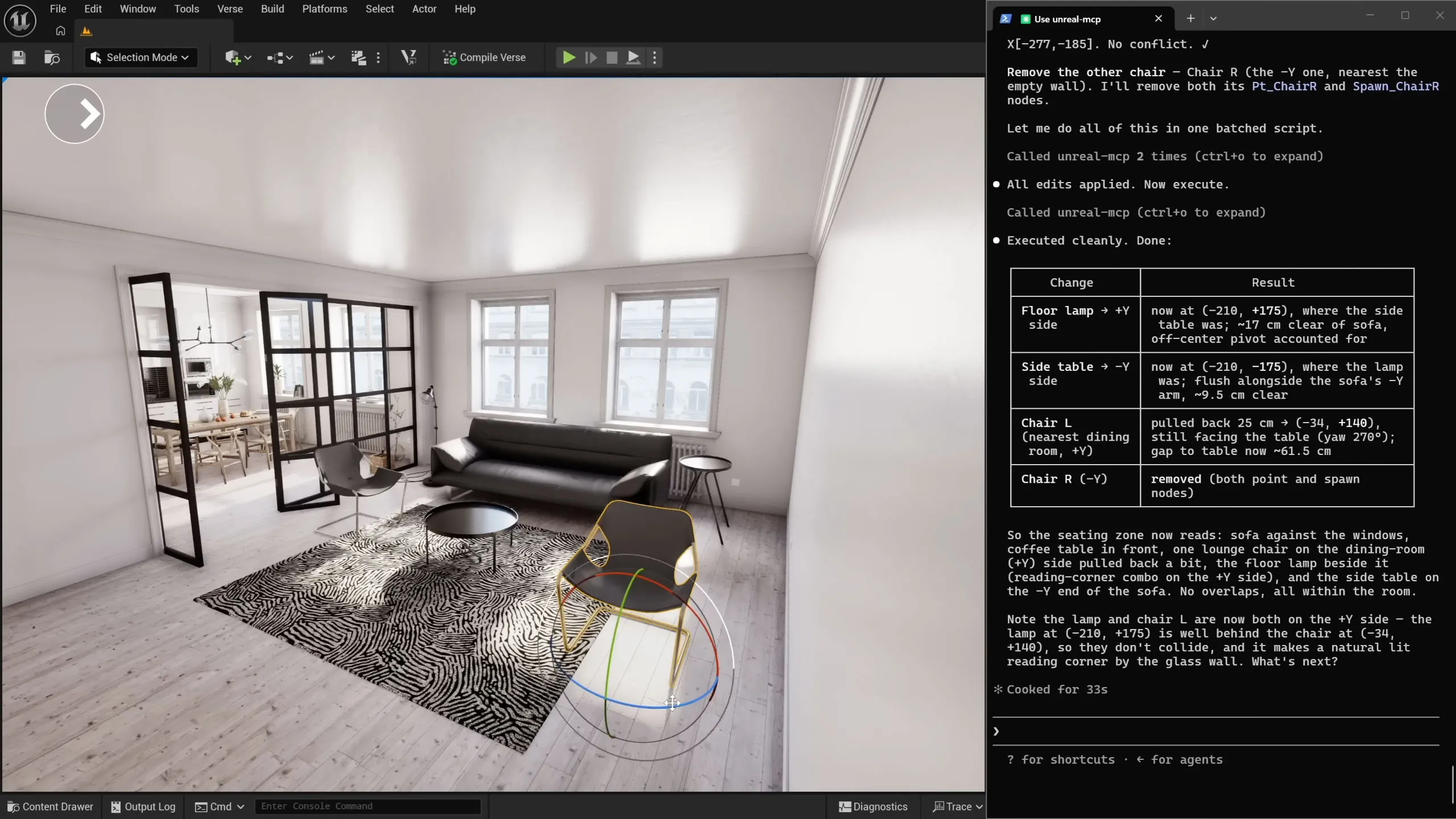
I expect that semantic search will eventually play an important role in CAD software. CAD software that’s organized around working with semantically rich primitives will likely be more amenable to AI-aided designing than those that just operate on primitive lines, shapes, and symbols.
AI as a vehicle for search will be extremely powerful in design contexts that involve a large number of assets. Think about the challenges that come with finding the right bolt from the McMaster-Carr catalog. The more the digital primitives of the McMaster-Carr catalog are imbued with information about what they’re good for and how they should be used, the easier it will be to find the fastener or component that will work for a particular job.
I expect that in the future, we’ll see CAD applications organized around primitive objects that contain rules for how they may be edited. This will make AI-assisted editing more predictable and results easier to trust.
CAD needs to evolve so that designers and engineers can work with digital primitives that accurately reflect real world counterparts. Just imagine being able to virtually design and assemble a machine with components that come with all of the embodied knowledge about how those components will perform in the real world. This will improve outcomes and be an important building block for CAD design tools running on top of simulations.
Once CAD software has a much better understanding of the things that make up a design, this will also make it easier for AI-based workflows to interact with the building blocks of designs in ways that respect what each building block can and can not be made to do.
5. 3D layouts used to direct AI and achieve more predictable results.
Another demonstration showed how the layout of 3D assets in environment becomes the basis for generating stylized video and images:
Giving users fine-grained control over the composition and appearance of AI generated videos has been a perpetual challenge with AI video generation tools. The work Epic has done here suggests that being able to describe what you want through the placement of geometry in 3D space over time is a far better vehicle for communicating intent than chat.
The demo included a couple of extra steps to ensure that the image generation model understood the space and could correctly apply the desired style to the space, but I’m guessing that over time, spatially aware models will be created, and the number of additional steps needed to ensure a good output will be reduced.


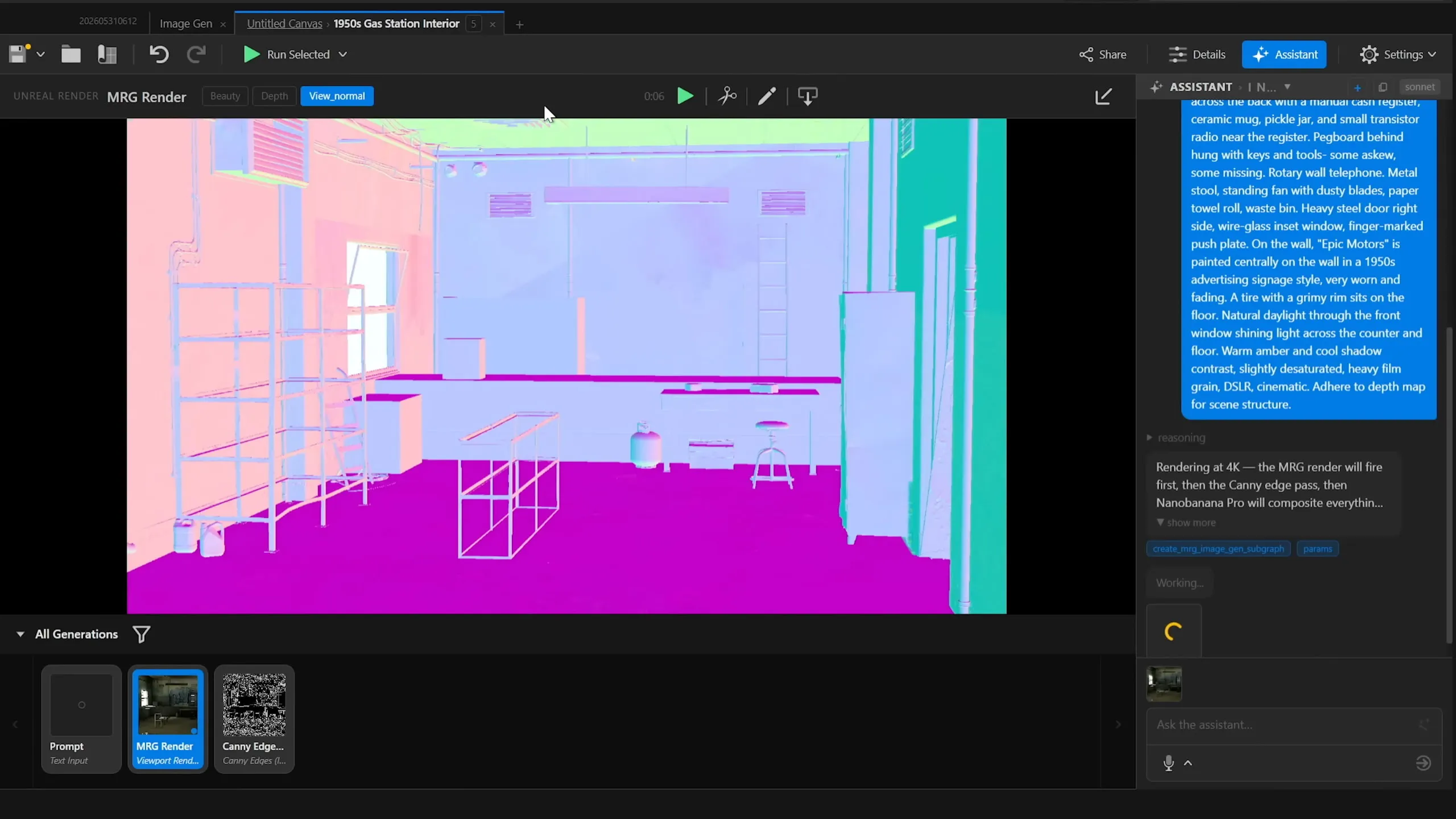
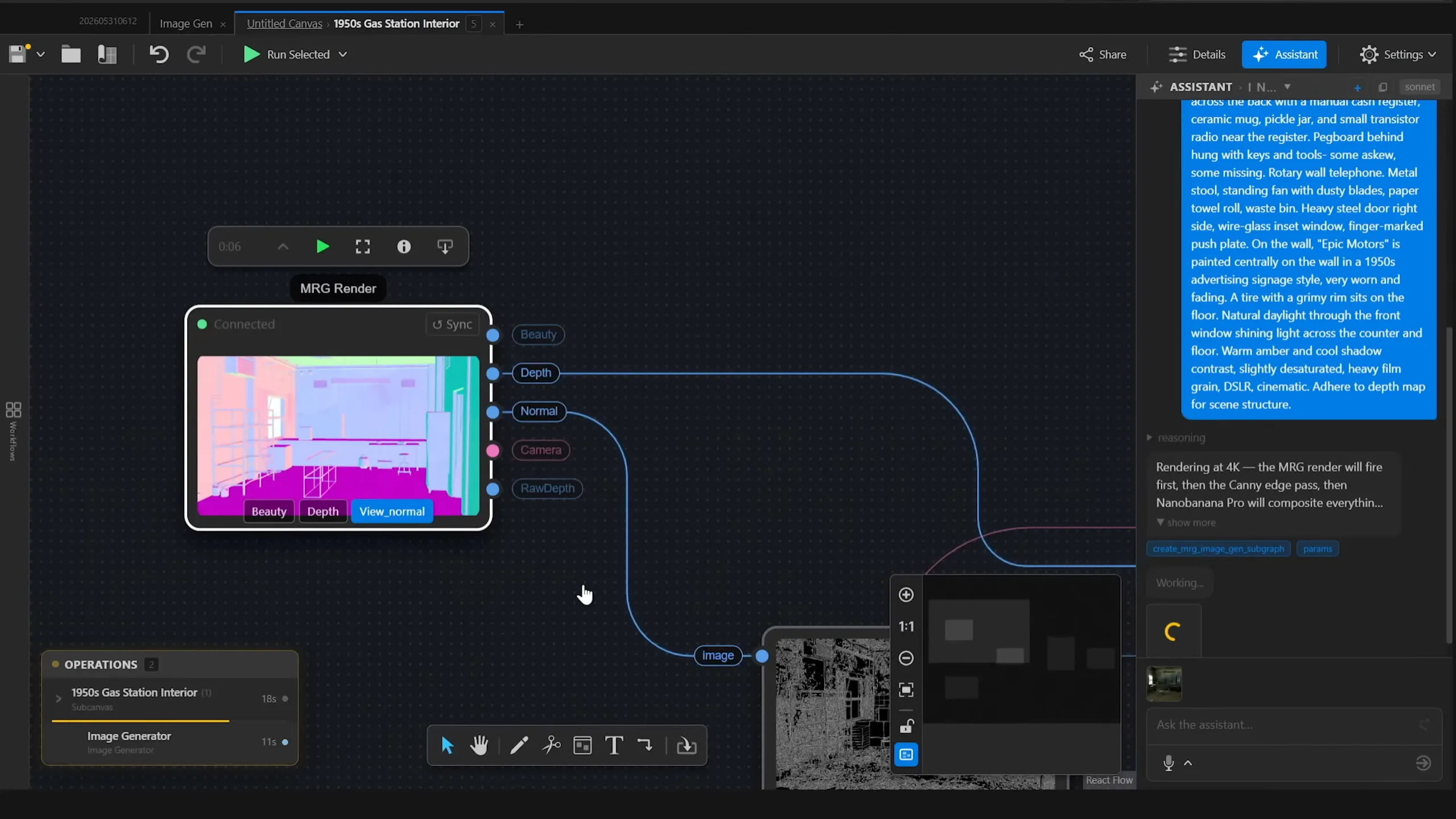
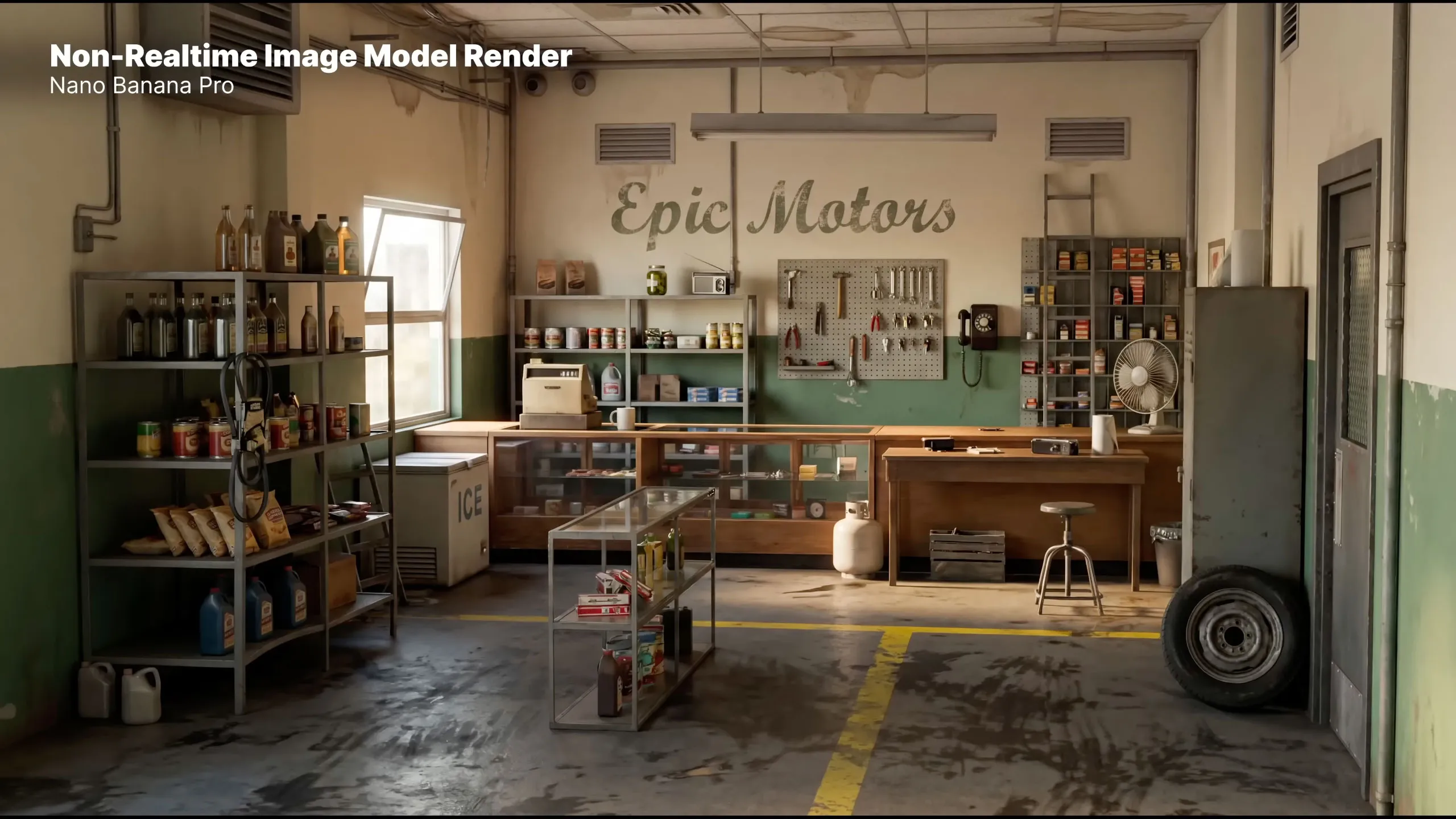
If this demo is anything to go by, I think as time goes on, it’ll become clear that far more expressive ways to communicate intent will result in far better AI output. Chat interfaces have the benefit of being very easy and cheap to implement and they’re very flexible. But words really aren’t the most efficient way to describe a great many useful things that exist in the real world, especially spatial ones.
The prompt used in this demo is a pretty inefficient way to specify how the scene should be composed. I’d expect in practice that an interior designer would want to construct such a thing in successive rounds, and would likely want to point directly at the objects to be styled.
Create a slightly worn 1950s American gas service station interior. Lightly dusty atmosphere. Two-tone walls — cream upper, institutional green lower — paint scuffed and chipped. White drop tile ceiling with water stains, exposed conduit painted over. Oil-stained poured concrete floor with worn traffic paths and a faded yellow safety stripe. Blocky rectangular metal shelving units lining the walls and standing freestanding, sparsely and irregularly stocked with period-correct products — glass oil bottles, canned goods, wax-paper snack packages, spark plug boxes, hanging fan belts, wire road map spinner. The rows of products on shelves should not look too neatly organized or duplicated. Generic label designs in red, yellow, and black, no recognizable brand logos. Ice chest cooler. A wooden glass-top service counter stretches across the back with a manual cash register, ceramic mug, pickle jar, and small transistor radio near the register. Pegboard behind hung with keys and tools- some askew, some missing. Rotary wall telephone. Metal stool, standing fan with dusty blades, paper towel roll, waste bin. Heavy steel door right side, wire-glass inset window, finger-marked push plate. On the wall, “Epic Motors” is painted centrally on the wall in a 1950s advertising signage style, very worn and fading. A tire with a grimy rim sits on the floor. Natural daylight through the front window shining light across the counter and floor. Warm amber and cool shadow contrast, slightly desaturated, heavy film grain, DSLR, cinematic.
The demo suggests that users and AI will eventually want to be able to express ideas and converse in 3D natively, just as developers and agents converse in structured language natively. This will result in more useful output in spatial contexts.
The ability for humans to create and generate text is built into every personal computer operating system. The ability to create 3D is still something that’s largely handled by specialist software. I expect that this will change as world models mature and become useful for real-world applications.
Epic’s AI demos suggest that pre-AI incumbent design tool makers may have some structural advantages over post-AI greenfield tool makers when exploring the future. Unreal’s architecture and capabilities gives it a head start on building AI-enabled tooling and workflows. They don’t need to build 3D authoring tools up from scratch in the way that generative AI text-to-video startups will.
6. Epic releases an open source version control application.
Another important announcement that has implications for CAD was Epic releasing open source version control software tailored for the needs of game development.

Source control systems like Git work well for code, but are less appropriate for binary content, which can form the majority of content in a game. Binaries are treated like monolithic objects and don’t benefit from the kinds of conveniences Git provides for code (diffing, etc.). Game developers have had to evolve processes for managing binary assets separate from source control, and the result is extra overhead and a more cumbersome development process.
The release of Lore isn’t accidental. If Epic wants to encourage the creation of a platform for distributing and connecting interactive experiences, then it has to solve the problem of how to integrate digital work product produced by large, distributed teams contributing to the same thing. The more people and agents contribute to a project, the more critical version control becomes.
Lore is still in the very early stages. Epic hasn’t yet implemented file locking to prevent someone from overwriting work, so it’s really only useful for high trust development contexts. However, since Lore is open source, I wouldn’t be surprised if capabilities like file locking will be implemented in relatively short order if game developers decide to adopt the software.
Epic’s release of Lore makes me think that powerful, granular, CAD-specific version control capabilities are likely price-of-entry for any serious generative AI workflow for CAD in architecture, engineering, and construction. It seems inconceivable that anyone would risk utilizing generative AI on mission-critical design projects without the ability to track granular changes and roll them back. Food for thought for any readers of this blog who are currently exploring generative AI for CAD.
I suspect that the needs that game developers have for version control overlap with the needs of large architecture and construction firms. Both involve a high degree of collaborative creation and both create a large number of binary artifacts.
Given that Lore is open source under the MIT license, it’s conceivable that it could be modified for the needs of CAD in AEC. Products like Revizto have simple version control, but nothing as comprehensive or low level as Lore.
7. Incorporating generative AI into authoring tools brings the attribution question into focus.
We’re entering an age where attribution in creative endeavors is an increasingly thorny and murky issue. Epic’s inclusion of AI tooling in Unreal Engine increases the likelihood that the tooling will be used, especially in a context that’s as competitive as the gaming industry.
Game developers who wish to publish their work to Valve’s Steam, the dominant distribution channel for PC games are required to disclose whether their games have been made with AI, and this can have an impact on public perception of the work.
The bet Epic is making is that AI will eventually be a part of all game production. Should this eventually happen then a Steam “Made with AI” label doesn’t convey enough useful information. The use of AI definitely raises issues of authorship and attribution which have copyright and intellectual property implications in game making.
One thing that might help is to be able to generate a record of how AI was used in the creation of a game. Perhaps Epic could build in some hooks between Unreal and Lore, Epic’s version control software. Since version control tracks changes made to software and assets, perhaps a record of AI-enabled changes could be recorded as well.
I think in the context of CAD software for architecture, engineering, and construction, the issue of AI attribution is an especially important issue to grapple with and attempt to resolve.
When you’re dealing with the design of a power plant, an airplane, or a skyscraper, the consequences of design and engineering flaws can be catastrophic. Even when issues of design and construction are not so dire, they can still result in lawsuits, financial repercussions, injuries, reputational damage, and lost jobs.
Given the consequences of a faulty generative design, or a design that’s derivative of copyrighted work, I suspect that the AEC software industry will eventually need to find ways to create detailed records of the generative work done during the course of a project, much like changes are tracked during the life of a complex design.
The inherent unreliability of LLMs suggests that the auditing of generative contributions to a design problem may need to be handled by deterministic systems. If CAD software were organized around semantically rich objects that contained the rules for how they may be modified, then it might also be possible to check the integrity of any changes made against the ruleset for changes that may be made.
More Reading
Personal Software
Building a single-purose application with Claude makes me wonder whether we're about to enter the age of personal software.
Steve Jobs In Exile
Thoughts on a recent talk at the Computer History Museum